
| Opening Screen | Embryo 8155 Figures | Download Section Images |
| Browse Sections | Flythrough Animations | Help / Instructions |
| 3D Models | Credits |
 |
||
|
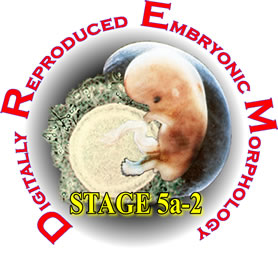
Stage 5a specimens have a postfertilization age of 7 to 8 days and are characterized by a trophoblast that is still mainly solid. The greatest diameter of the trophoblastic shell is less than 0.5 mm. The endometrial stroma is edematous. The blastocystic cavity is flattened usually because of collapse of the conceptus during implantation. Endoblast formation begins along the inner side of the trophoblast. The embryonic disc is approximately 0.1 mm in diameter and is composed of two layers, a thick layer called the epiblast and a thin layer called the hypoblast. The amniotic cavity is apparent for the first time and is formed above the curved epiblast of the embryonic disc. Stage 5a is represented in the DREM databases by two Carnegie embryos; a younger one (#8020) and an older one (#8155). The older stage 5a specimen (5a-2) is Carnegie embryo #8155 that has an estimated postovulation age of 8 days and had been given a grade of excellent. The conceptus shows later superficial implantation being almost imbedded within the endometrium and nearly flush with the endometrial epithelium. The abembryonic pole is barely exposed to the uterine cavity. The amniotic cavity is prominent and amnioblast are present. The embryonic disc is dorsally concave. The epiblast is composed of pseudostratified columnar eipithelium with only one mitotic figure evident. The hypoblast is composed of a cap like mass of smaller polyhedral cells with large nuclei that nearly fill each cell. The trophoblastic shell is composed largely of syncytiotrophoblast and varies from the thin indifferent type at the abembryonic pole to the thick, irregularly convoluted part at the embryonic pole. The embryonic pole is composed almost entirely of syncytiotrophoblast. The syncytiotrophoblast shows no definitive evidence of lacunae but intracytoplasmic vacuoles are seen occasionally. There are a few extraembryonic endoblast cells scattered around the periphery of the blastocystic cavity but too few to form the exocoelomic membrane. The embryonic disc measures 0.0030 x 0.050 x 0.090 mm. The trophoblastic shell measures 0.150 x 0.210 x 0.306 mm and the blastocystic cavity measures 0.066 x 0.082 x 0.168 mm. (click to see Table of Dimensions from Hertig & Rock, 1949) The specimen was prepared for microscopic examination in 1943. It was fixed in Bouin's fluid and 70% alcohol, embedded in celloidin paraffin and cut at 6 µm. The sections were mounted on glass slides and stained with H & E. There are 42 sections through the conceptus and 14 sections through the embryonic disc. Structures are identified in every section image. The morphology of this embryo is well documented in the literature. It was first described by Drs. Hertig, A.T. and Rock J. in 1949 (Carnegie Instn. Wash. Publ. 221, Contrib. Embryology, 33:169-186). A reconstruction of the conceptus at its greatest diameter together with the related maternal blood vessels is illustrated in that publication. The sections have been digitally restored and labeled, and can be viewed at three magnifications. Several 3D reconstructions have been produced from the aligned sections. Animations of these 3D-reconstructions together with fly-through animations of the aligned sections are also included on the disks. For anyone who wishes to use them for other reconstructions, research or presentations, all of the original section images are available as individual .jpg files or as zip files . Instructions for using the disks can be found by going to theInstructions section from the opening screen. |
||